
Baytown, TX · Garage Door Service
Openers and Power Outages in Baytown Homes
Baytown homes mostly date 1956-2011, median 1983, with mild but freeze-prone weather. Here's what that means for your opener during a power outage.
- Repairs & new doors
- Springs & openers
- Serving 4 nearby communities
Checking It Yourself
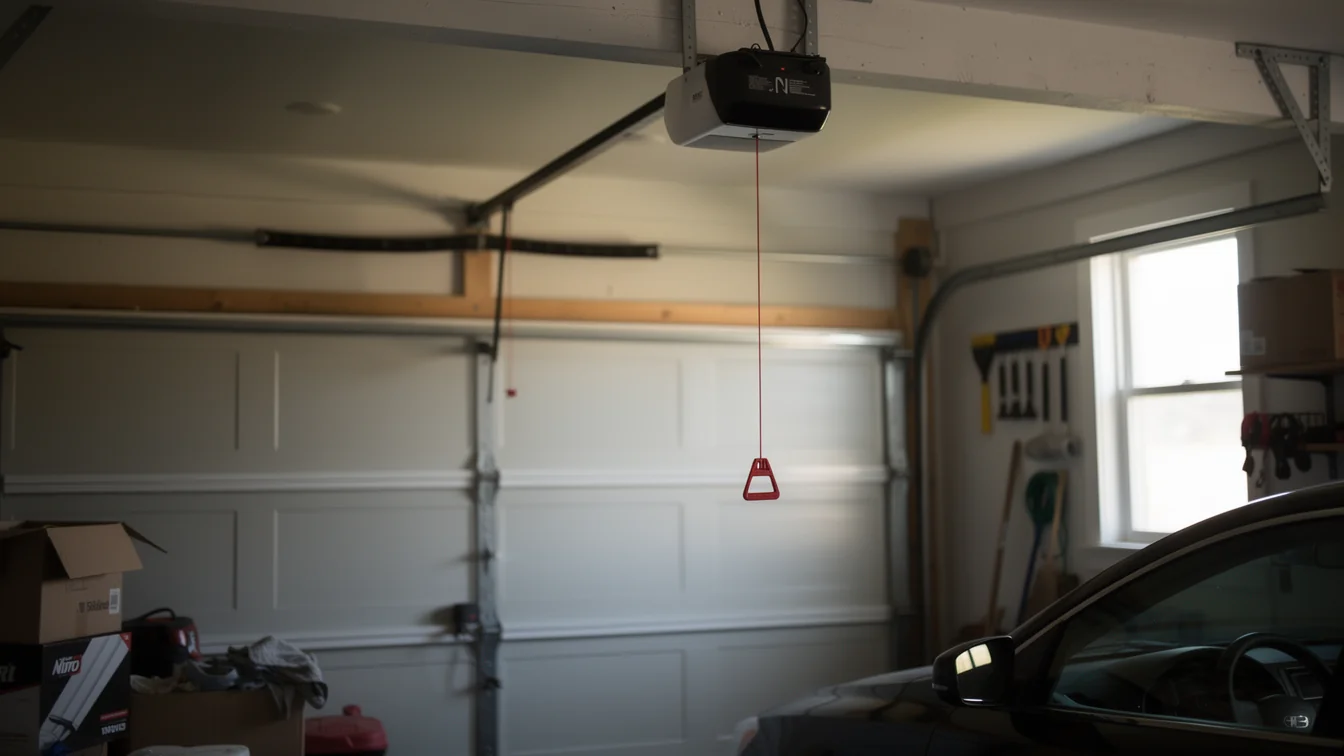
Find the manual release cord on your opener rail - it's the red handle hanging down near the motor head. Pull it straight down and the trolley disengages from the chain or belt, letting you lift the door by hand. Every opener has one; if you've never pulled yours, do it once before you need it in the dark.
If your opener has a battery backup box bolted to the unit or mounted nearby, press the test button. A lot of the openers running in houses built across this stretch of the 1960s through the early 2000s were installed well before battery backup became a standard add-on, so don't assume yours has one just because it's newer than the house.
Listen for the motor hum when you hit the wall switch with power connected. A hum with no movement usually means the gears inside the unit are stripped - common once an opener passes the fifteen-year mark, which plenty here have. A clean click with nothing at all points to the circuit board itself, not the motor.
One limitation worth saying plainly: we can't test a battery backup that isn't there. If your opener predates that feature, the fix is a new unit, not a repair.
What the Weather Here Does to It
Baytown sits in a mild band with occasional freezes, not the deep-freeze cycling that cracks plastic gears up north, but enough swing that circuit boards inside older openers go through more thermal stress than people assume from a place that rarely sees snow. Humidity is the bigger daily factor - moisture works into unsealed logic boards and corrodes contact points over years, which shows up as an opener that works fine most days and then refuses to respond after a storm knocks the power out and back on.
That power-cycle moment is where most opener failures actually surface. The board resets, and on units from the older end of the local housing stock - plenty of which went up decades before smart openers existed - that reset doesn't always take cleanly. You end up holding the remote, pressing it, and getting nothing, not because the remote died but because the board behind it needs a hard reset at the unit itself.
We don't chase every weather theory. What we know is the pattern: outages plus older boards equal more service calls in the days right after.
The Situation
Housing in this area runs from the mid-1950s through 2011, with the bulk of it built out in the 1980s and 90s across the mix of neighborhoods that make up this part of the Gulf Coast. That means a lot of garages are still running the opener that came with the house, or close to it - units old enough that a power outage doesn't just pause them, it can knock the logic board back to a state it doesn't recover from without a technician resetting the travel limits by hand.
With 38,419 owner-occupied houses in the service area, that's a sizable number of garages where the opener is original or close to it, paired with a door that's seen thirty-plus years of Gulf Coast humidity on its hardware. A median household income of $72,937 here means most people are weighing a $200 board repair against a $400-plus full opener swap, and that math depends entirely on how old the rest of the unit already is.
We'll tell you straight when a board fix isn't worth it on a motor that's already failing elsewhere.
What Most People Get Wrong
The biggest one: people think unplugging the opener and plugging it back in resets everything, the way it does with a router. Garage door openers don't work that way. The travel limits, the force settings, and in some units the remote codes are stored on a board that can get confused by a hard outage, and a simple unplug-replug doesn't clear that confusion - it just powers the same bad state back up.
Second: assuming a newer house means a newer opener. Plenty of houses here were built in the 1980s and 90s and still carry the original chain-drive unit from that era, because nobody replaces an opener until it actually quits. Age isn't visible from the driveway.
Third: treating the battery backup as optional once it's installed. If yours has one and the test button doesn't light up, that battery is dead, not dormant, and it won't save you during the next outage no matter how new the opener looks. Replace it before you need it, not after.
Frequently asked questions
Why did my opener stop responding after the power came back on?
On older units, a hard power outage can reset the logic board into a state where it ignores the remote until someone manually re-teaches the travel limits at the unit. It's not the remote's battery - it's the board needing a reset, which is a five-minute fix once we're there.
Does my opener need a battery backup given Baytown's weather?
The climate here is mild with occasional freezes, so it's less about cold and more about humidity corroding contacts and storms cutting power. A battery backup means your door still opens during an outage. Plenty of older openers in this area were installed before that feature was standard, so check yours.
Is it worth repairing an opener from the 1980s or 90s?
Depends on what's failing. A board replacement on an otherwise sound motor can make sense. If the motor itself is already straining or the gears are stripped, you're usually better off replacing the whole unit rather than patching an opener that age piece by piece.
Related garage door services in Baytown
More garage door guides
Book garage door service in Baytown
Call now or request a quote - tell us what the door is doing and where you are.