
Baytown, TX · Garage Door Service
Why Your Garage Door Keeps Jumping Its Track
Baytown's 1956-2011 housing stock and Gulf Coast humidity both play a part in why tracks bend or pull loose. Here's what to check and what we actually see on calls.
- Repairs & new doors
- Springs & openers
- Serving 4 nearby communities
Checking It Yourself
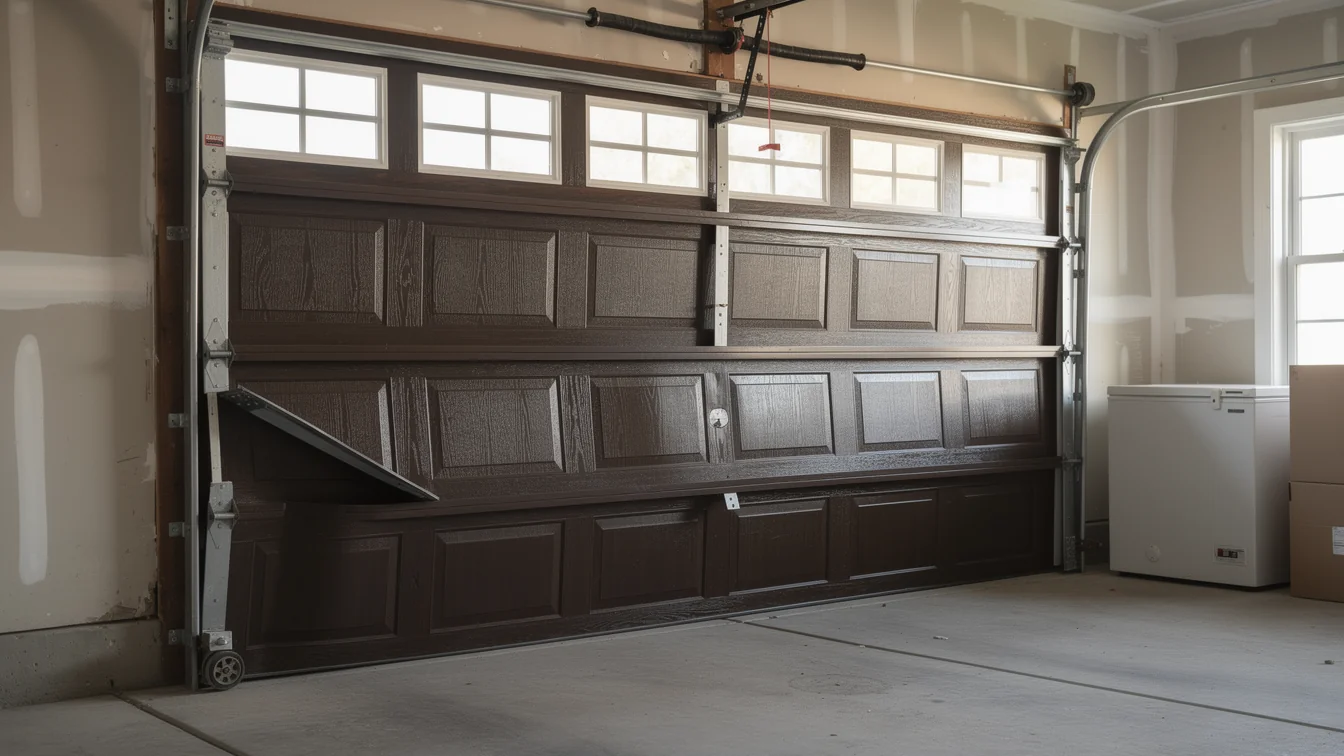
Open the door halfway and look at the tracks on both sides. You're checking for three things: a gap between the roller and the track, a bend you can see with a straightedge held against the rail, and loose lag bolts where the track bracket meets the framing. On a lot of the houses we go into around here - built anywhere from 1956 up through the early 2000s, with most of the stock dating to the 1980s and 90s - the bracket hardware is original. Thirty-plus years of the door running up and down works those lag bolts loose a quarter-turn at a time, and a loose bracket lets the whole track rail shift a few degrees out of plumb. That's enough for a roller to walk off the lip on the next cold start. If you see daylight between the roller and the track on one side only, that's your bent section, and it usually traces back to someone backing into the door at some point, not the track failing on its own. We don't recommend trying to bend it back yourself - a track that's been muscled straight with a pipe wrench rarely tracks true again, and you end up paying for a new section anyway.
What the Weather Here Does to It
This area sits in a mild climate band with occasional freeze, which doesn't sound like much compared to places that get real winters, but it's exactly the kind of swing that works on galvanized track hardware over time. Gulf Coast humidity keeps moisture sitting on the zinc coating most of the year, and the handful of freeze nights we do get each winter make the metal contract just enough to loosen whatever rust has already started eating at the bolt threads. On a track bracket that's been up since the house was built - and a lot of these houses date to the early 80s - that's decades of expansion and contraction with no attention paid to it. We see more off-track calls in the weeks after a cold snap than any other time of year, not because the cold bends anything, but because it's the final nudge on hardware that was already loose from humidity and age.
The Situation
Across the areas we run trucks to - Highlands, Mont Belvieu, Old River-Winfree, Crosby, and the rest of the 22 named areas out to about 19 miles - the housing stock runs from 1956 up through 2011, with the median build year sitting around 1983. That matters for track problems specifically because a door on a house from that era is old enough that the track hardware has had real time to work loose, but the door itself usually isn't old enough that a full replacement is the obvious call. That's the gap we work in most: original or early-replacement track on a door that's otherwise sound. With 38,419 owner-occupied houses across this service area, that 1980s-era bracket setup is the single most common thing we open the truck for on an off-track call.
What Most People Get Wrong
The most common mistake is treating an off-track door as a track problem when it's actually a spring or cable problem that just shows up as the door running crooked. If one side of the door drops faster than the other, the track on the slow side takes the extra load and that's what eventually pulls the roller out. Tightening the bracket bolts without checking the spring tension just buys you a few more weeks before it happens again. The other mistake is assuming a bent track section can be hammered straight. It can be straightened enough to look right and still throw a roller every tenth cycle, which is worse than leaving it bent in a way you can see and plan around. If the bend is in the vertical section near the bottom roller, that section usually needs to be swapped, not repaired - we won't put a quote in for a bend fix if the metal's already fatigued, because it won't hold.
Frequently asked questions
Why does my garage door only jump the track on one side?
That's almost always a bracket or roller problem on that specific side, not a track defect running the whole length. Check the lag bolts where the track meets the wall first - on houses from the 80s and 90s around here, those are usually the originals and they work loose over the years.
Can a bent track be fixed instead of replaced?
Sometimes, if the bend is minor and in the horizontal section. Once the metal's been bent and straightened once, though, it's weaker at that point and more likely to go again. We'll tell you honestly when a section's done rather than bend it back and send you a bill for a fix that won't last.
Does the weather here actually affect garage door tracks?
Indirectly, yes. The humidity this area sees most of the year works on galvanized hardware over time, and the occasional freeze night is often what finally loosens a bolt that was already rusting. It's less dramatic than ice storms elsewhere, but it adds up over a few decades.
Related garage door services in Baytown
More garage door guides
Book garage door service in Baytown
Call now or request a quote - tell us what the door is doing and where you are.